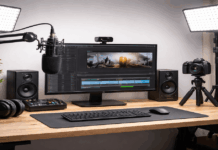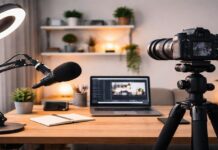
A shaky talking-head video kills your credibility faster than bad lighting. And if you record at a desk or in a spare bedroom, the tripod under your camera matters more than you think.
Picking the best tripod for home video recording sounds simple until you start comparing fluid heads, payload ratings, and height ranges across ten different product pages.
I spent weeks comparing specs on tripods between $24 and $685 for home creators. The price gaps are wild, but the performance gaps are smaller than the marketing wants you to believe.
This breakdown covers the tripods that make sense for real home video setups in 2026, grouped by what kind of creator will get the most out of each one.
Why the Tripod Head Matters More Than the Legs
Every tripod review focuses on weight, height, and materials. But for home video, the single biggest factor is the head sitting on top of those legs.
A fluid head gives you smooth, drag-controlled pans and tilts. A ball head snaps into position fast, which is great for photography but terrible for video movement.
If your content involves any camera movement at all (panning across a desk setup, tilting down to a product, slow sweeps for B-roll) a fluid head is the difference between footage that looks intentional and footage that looks like someone bumped the camera.
Fluid Head vs. Ball Head for Video
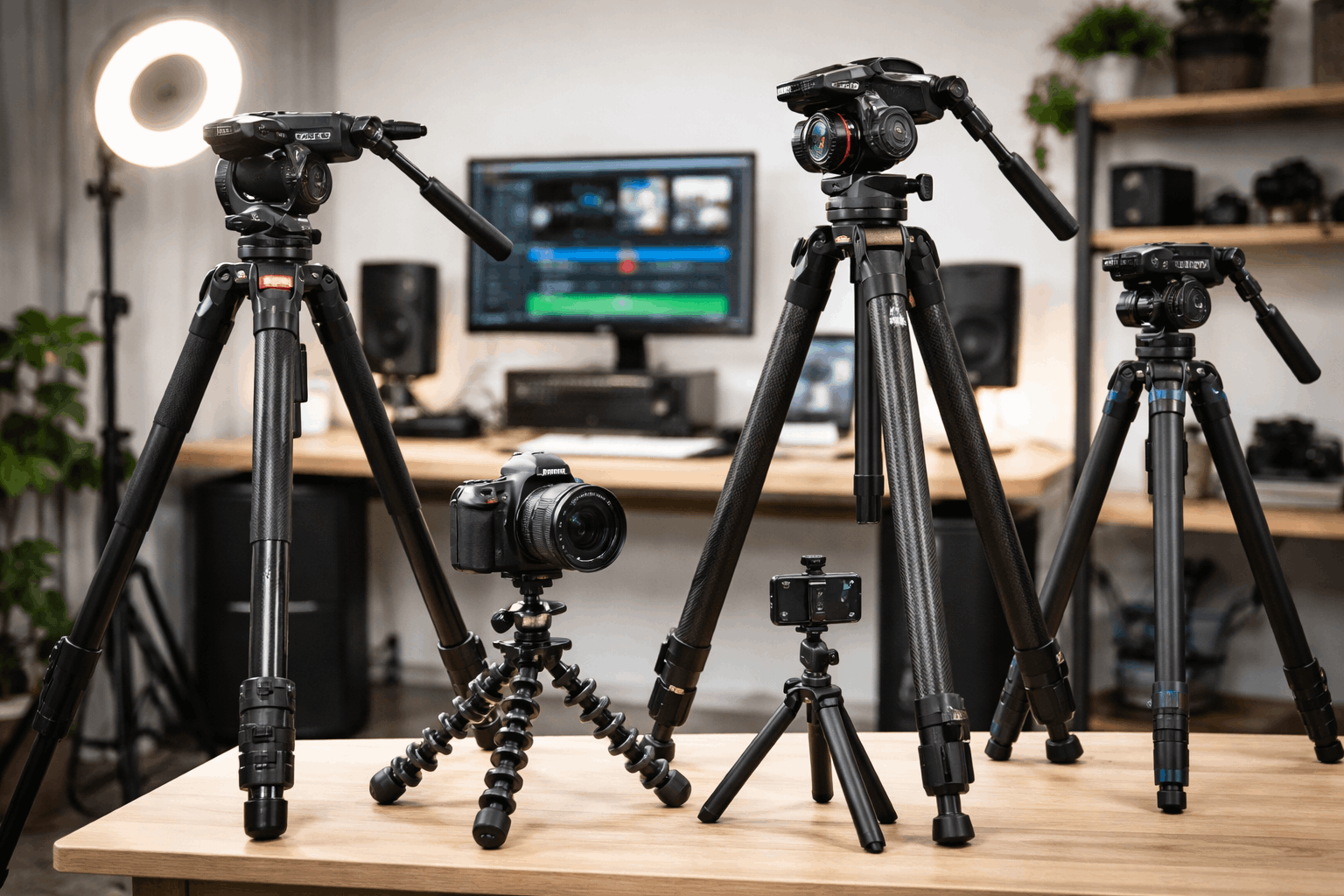
A ball head locks into one position. That’s useful for photo shoots where you frame once and fire. But video demands controlled, repeatable motion.
A fluid head uses internal damping to resist your hand movements, so a slow pan across a desk feels cinematic rather than jerky.
Every tripod on this list includes a fluid head. I would not recommend a ball-head tripod for any home video creator recording in 2026, even if the price looks tempting.
Counterbalance: the Spec Nobody Checks
Counterbalance is the spring tension inside the head that offsets the weight of your camera. Cheap fluid heads have zero counterbalance, so when you tilt up or down, the camera drifts.
Better heads let you dial in the counterbalance to match your rig’s weight. The Sachtler Ace M system at $685.75 has adjustable counterbalance. The SmallRig AD-01 at $159.99 does not. That’s one of the real reasons for the price gap.
Best Budget Tripods for Home Video Under $250
The sweet spot for a first real video tripod sits between $130 and $250. Anything below that tends to cut corners on the fluid head, which defeats the purpose. Three tripods in this range stood out after comparing payload, height, and head quality.
SmallRig AD-01 Heavy-Duty Tripod: $159.99
This is the tripod I would point a new home creator toward first. A 17.6 lb load capacity handles any mirrorless camera with a kit lens, a small monitor, and a shotgun mic without breaking a sweat.
The height adjusts from 33 to 73 inches, which covers seated desk recording and standing shots.
The SmallRig AD-01 is built heavier than travel tripods, and that weight is a feature. Heavier legs absorb more vibration from floors, footsteps, and accidental bumps. If your tripod lives in one room, portability does not matter.
Suited for: mirrorless and DSLR rigs, YouTube talking heads, product demos, lightweight teleprompter setups.
Benro KH25PC Video Head and Tripod Kit: $159.95
The Benro KH25PC sits at nearly the same price as the SmallRig but takes a different approach.
It ships with a mid-level spreader connecting the legs, which adds serious stability on smooth surfaces like hardwood or tile. The payload capacity is 15 lb with a height range of 29.5 to 61.6 inches.
That shorter max height is the tradeoff. If you record standing, 61.6 inches may leave the camera too low. For seated desk shots, though, it’s a non-issue.
Suited for: indoor recording on smooth floors, seated content, small home studios.
Sirui SH25 Aluminum Video Tripod: $149.00
At $149, the Sirui SH25 is the least expensive purpose-built video tripod on this list. It handles basic locked-off framing well: plant the camera, frame the shot, press record.
The fluid head allows some panning, but the drag and counterbalance feel noticeably cheaper than the SmallRig or Benro options above.
Suited for: beginners, fixed-position recording, simple webcam-style framing.
The comparison below breaks down these three budget picks side by side:
| Feature | SmallRig AD-01 | Benro KH25PC | Sirui SH25 |
|---|---|---|---|
| Price | $159.99 | $159.95 | $149.00 |
| Payload Capacity | 17.6 lb | 15 lb | ~11 lb |
| Height Range | 33–73″ | 29.5–61.6″ | ~27–60″ |
| Spreader | No | Mid-level | No |
The SmallRig AD-01 wins on payload and height range, making it the safer pick if you plan to add gear to your rig later.
Also read: Color Temperature Explained for Home Video
Mid-Range and Pro Tripods for Serious Home Production
Once your content outgrows a budget tripod, or once shaky pans start bothering you, the $200 to $700 range opens up tripods with better fluid heads, carbon fiber legs, and studio-grade leveling systems.
Magnus VT-3500C Carbon Fiber System: $219.99
Carbon fiber legs at $219.99 is a reasonable price for the weight savings. The Magnus VT-3500C supports a 26.4 lb maximum load, which is overkill for most mirrorless setups but useful if you add a heavier lens, a monitor, or a teleprompter down the road.
Carbon fiber also dampens vibration better than aluminum at the same weight.
I think carbon fiber is overrated for tripods that never leave the house, though. The Magnus VT-3500C weighs less than aluminum alternatives, but if your tripod sits in the same corner of your office permanently, saving two pounds means nothing.
The $219.99 price only makes sense if you move between rooms or locations.
Manfrotto 645 FAST + 504X Fluid Head Kit: $629.88
This is where home video starts feeling like a real production. The Manfrotto 645 FAST tripod system pairs fast-leveling legs with the 504X fluid head, which has adjustable counterbalance and smooth drag control.
Slow pans during product shots come out noticeably cleaner on this head compared to anything under $300.
The $629.88 price tag is steep for a home setup. But if you record daily, sell courses, or produce client work from a home studio, the time saved on leveling and the improvement in motion quality can justify it.
Sachtler 75/2 Mark II + Ace M System: $685.75
Sachtler builds tripods used in broadcast studios and film sets. The Ace M system at $685.75 (promo pricing) has an 8.8 lb load capacity with a height range of 22.8 to 68.1 inches using the ground spreader.
That 8.8 lb payload is lower than cheaper options on this list, which sounds counterintuitive at this price.
The reason: Sachtler’s counterbalance and drag systems are tuned for precision within that weight range.
A lighter payload rating with better internal mechanics produces smoother motion than a higher-rated head with cheap internals. This tripod rewards creators who use mirrorless cameras without heavy accessories.
Only worth it if you record frequently and camera motion quality is a priority for your content.
Small Tabletop Tripods for Second Angles
A full-height tripod handles your main camera. But if you shoot product close-ups, hand demos, or behind-the-scenes clips, a tabletop tripod as a second support rounds out the setup.
JOBY GorillaPod 5K Kit: $129.95
The GorillaPod 5K wraps around shelves, clamps to desk edges, and sits on tabletops. It supports up to 11 lb, which covers most mirrorless cameras.
This is a secondary support, not a replacement for a full tripod. But for a second angle during unboxing videos or cooking content, it fills a gap that a full-height tripod physically cannot.
Manfrotto PIXI Mini: $24.45
The cheapest option on this list. The PIXI holds a compact camera or lightweight webcam on a desk. It does not pan, tilt smoothly, or support heavy rigs. But at $24.45, it solves one problem perfectly: giving a small camera somewhere stable to sit.
Check B&H Photo for current pricing and availability on all models listed here.
Tripod Buying Mistakes Home Creators Make
Knowing what to buy is half the equation. Knowing what to avoid saves money and frustration. These are the mistakes I see repeated across forums and creator communities:
- Matching payload to the camera body alone. Add your lens weight, quick-release plate, shotgun mic, and any small monitor. A camera body might weigh 1.5 lb, but the full rig can hit 4 to 6 lb easily.
- Ignoring floor leveling. Home floors are rarely perfectly flat. A tripod with a leveling bowl or fast-adjust legs saves minutes of setup time on every single shoot.
- Buying a travel tripod for a permanent setup. Compact legs save weight but transmit more vibration. If the tripod never leaves your room, buy the heavier, sturdier option.
- Spending $600+ before you know what you need. A $160 SmallRig AD-01 handles a 17.6 lb payload. Unless you already know you need precise counterbalance or broadcast-grade drag, starting cheaper and upgrading later is a smarter path.
I disagree with the popular “buy once, cry once” advice for tripods. The SmallRig AD-01 at $159.99 handles 17.6 lb of gear, which covers every mirrorless and DSLR rig a home creator would reasonably assemble.
Spending $629 on a Manfrotto 645 FAST kit before you even know whether your content needs smooth panning is spending money to solve a problem you might not have.
Questions People Ask About Tripods for Home Video Recording
Q: Do I need a video tripod if I only record talking-head videos?
Even locked-off talking-head footage benefits from a stable tripod. Handheld or cheap tripods introduce micro-vibrations that show up on large screens. A fluid head also lets you reframe between takes without moving the whole rig.
Q: Can I use a phone on a video tripod?
Absolutely. A phone clamp adapter (usually $10 to $20) attaches to any standard tripod head. The SmallRig AD-01 and Benro KH25PC both accept standard 1/4″-20 thread mounts, which is what phone clamps use.
Q: Is carbon fiber worth the extra cost for home recording?
For a tripod that stays in one room, probably not. Carbon fiber’s main advantage is reduced weight for transport. Aluminum tripods at the same price point often put the savings into a better fluid head, which matters more for video quality.
Q: How tall should a home video tripod be?
Measure the height of your recording position. For seated desk content, 50 to 60 inches is usually enough. Standing content needs 65 inches or more. The SmallRig AD-01 reaches 73 inches, which covers both scenarios.
Q: Should I buy a tripod with a spreader?
Spreaders add lateral stability on smooth floors like hardwood and tile. The Benro KH25PC includes a mid-level spreader at $159.95. If your recording space has hard, smooth flooring, a spreader-equipped tripod can feel noticeably more planted.
Conclusion
A good tripod removes a problem you should never have to think about during recording. The SmallRig AD-01 at $159.99 handles the widest range of home setups at the lowest reasonable price.
Upgrading later makes sense once your content tells you exactly what performance gap to fill. Start stable, record clean footage, and let the work itself decide when better gear earns its cost.