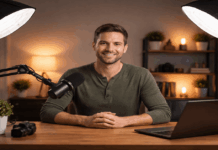
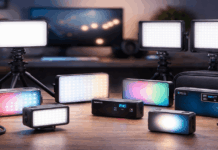
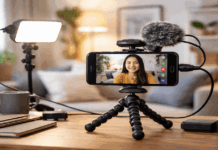
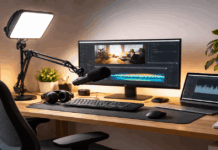
Soft lighting is one of the fastest ways to make a home video look more professional, even if you are filming on a phone or a basic webcam.
You do not need a studio kit to get it. You need to shape light with simple tools you can find at home or buy cheaply.
You can make a small light behave like a large one by diffusing it, bouncing it, or moving it closer in the right way.
Understand the three controls that create “soft”
Before you change anything, remember these three controls. They work with any light, from a window to a desk lamp.
Size of the source
A bigger source creates softer shadows. A window is big, so it is naturally soft. A bare bulb is small, so it is harsh.
Distance to the subject
The closer the source is (while still staying outside your frame), the softer it appears.
If you push a light far away, it becomes smaller in relation to you and the shadows get harder.
Diffusion and bounce
Diffusion spreads and softens the beam. Bounce turns a small light into a larger “reflected” source by aiming it at a wall or board.
Once you understand these, you can “build” soft light from almost anything.

Use window light as your free softbox
If you can control daylight, you already have a strong soft-light option.
Place yourself correctly
Sit facing the window at about a 30–45° angle, not with the window behind you.
Backlighting from a bright window forces your camera to expose for the background, which usually makes your face too dark.
Add simple diffusion
If the sun is direct and harsh, soften it with a thin white curtain, a shower curtain liner, or a clean white sheet.
The goal is to spread the light, not block it completely.
Control the shadows
If one side of your face looks too dark, place a white surface on the shadow side.
A foam board, a white poster board, or even the back of a large notebook can act as a reflector. This “fills” shadows without adding another light.
Window light is quiet, which matters if you are recording with a microphone nearby.
Turn cheap lamps into soft lights with diffusion
A common mistake in home setups is using a bright lamp with no diffusion, pointed straight at the face.
That gives hard shadows and shiny skin. You can fix that with a few safe, simple options.
Diffuse with a frame
A basic method is to put a translucent material between the lamp and your face.
Good low-cost options include a white shower curtain, tracing paper, or a white bedsheet.
Keep the material far enough from the bulb to avoid heat issues. If you are using older hot bulbs, switch to LED bulbs first.
Use a “bounce” instead of pointing at you
Aim the lamp at a white wall or a large white board so the reflected light becomes your new source. The wall acts like a giant softbox.
This often looks more natural than direct light, especially for webcams and phones.
Make the light bigger with a wider surface
If your light is small, give it more surface area.
A large white board placed close to you and lit from the side can create a soft, even look, especially for seated talking-head videos.
Build an easy two-piece setup: key light + fill
You can get soft, balanced lighting with two simple “roles,” even if you only have one real light.
Key light (your main soft source)
This can be a window, a diffused lamp, or a bounced lamp. Place it slightly above eye level and off to one side.
If it is too high, you get strong under-eye shadows. If it is too low, the look can feel unnatural.
Fill (your shadow softener)
Fill does not need to be a second lamp. A reflector is often enough. Put a white board on the darker side of your face until the contrast looks balanced.
If the result looks flat, move the reflector farther away so you keep some shape.
This is a practical approach for creators who also need space for a microphone, a tripod, and a desk. It keeps the setup simple and repeatable.
Use the “bigger and closer” trick for webcams and phones
Webcams and phones tend to sharpen faces and exaggerate contrast in bad lighting. Soft light helps more than expensive camera upgrades.
Bring the light close, but keep it out of frame
A small LED panel can look surprisingly soft if it is close and diffused. A desk lamp bounced off a white board can do the same.
Your camera will also need less gain, which reduces noise in the image.
Keep the light slightly above the lens
If the light is far off to the side, webcams can make one side of your face look too dark. A gentle 20–30° angle usually looks clean and natural.
Control color temperature for a clean look
Softness is not only about shadows. Color matters because mixed lighting looks messy on camera.
Pick one “type” of light
Avoid mixing daylight from a window with warm room lamps unless you can match them.
If you use a window, turn off warm lamps nearby. If you use lamps, close blinds or curtains to reduce daylight.
Match bulbs if you use multiple lamps
If you add a second lamp, use the same kind of LED bulb in both. Matching color reduces editing work later and helps skin tones look natural.
Reduce harsh shadows with flags and “negative fill.”
Sometimes the problem is not a lack of light. It is uncontrolled light bouncing everywhere.
Use “negative fill” for the shape
If your lighting looks too flat, place a dark object (a black shirt on a chair, a dark towel, or a black foam board) on one side of your face, just out of frame.
This absorbs stray light and adds gentle contrast.
Block the light that creates glare
If a bright lamp is hitting the wall behind you, it can reflect into the lens, reducing contrast.
Use a piece of cardboard or a book as a small “flag” to block the spill.
These are small adjustments, but they make home lighting look more intentional.
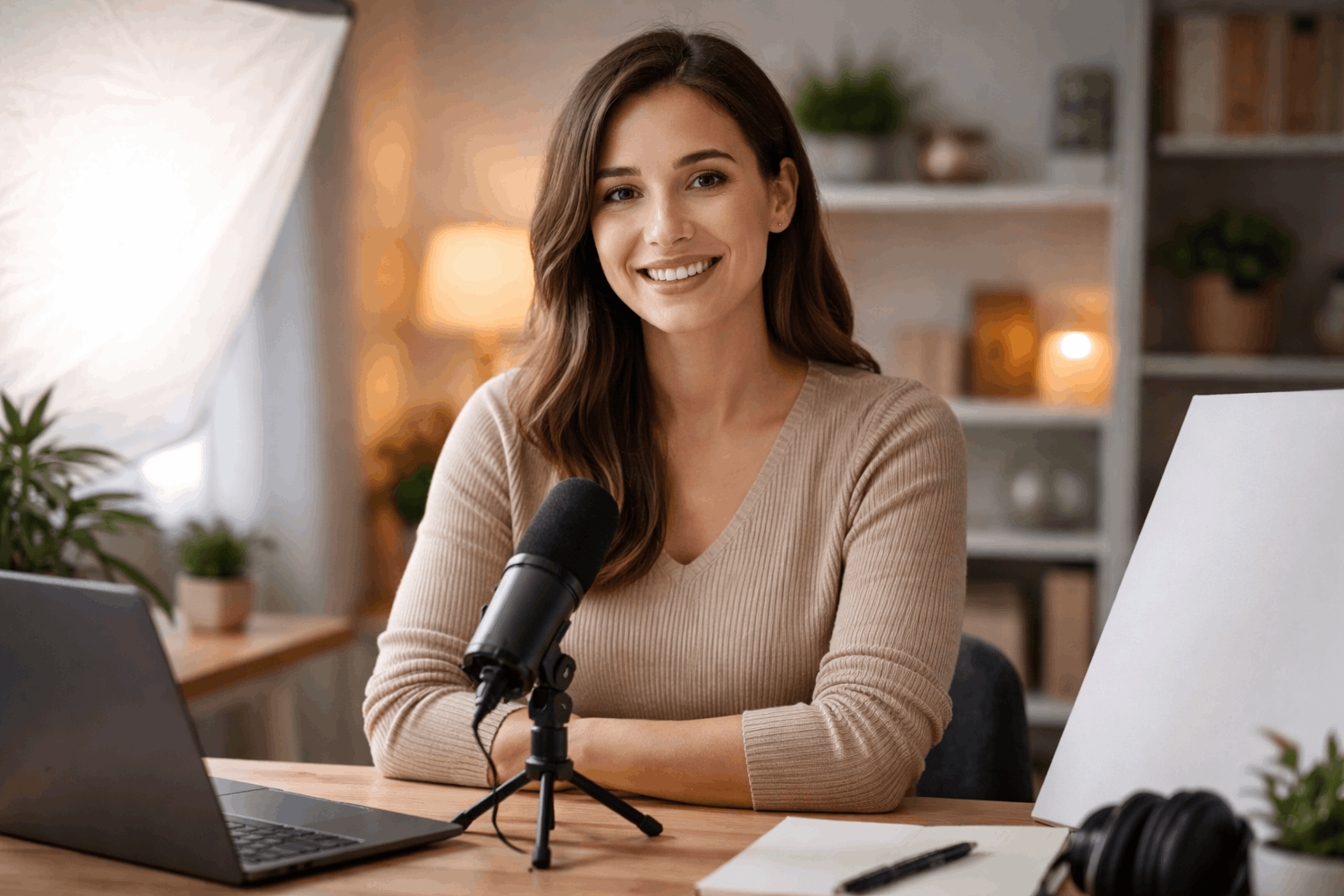
Create separation from the background without extra gear
Soft lighting on your face is the priority, but separation helps the whole image.
Add distance from the wall
If you sit too close to a wall, shadows become visible and distracting. Pull your chair forward so there is space behind you.
Use a practical light in the background
A small lamp in the background can add depth. Keep it dimmer than your face and avoid placing it where it creates a bright hotspot.
Conclusion
Your main light is large (window, bounce, or diffusion) and close. The key light is slightly above eye level and off to one side.
Shadows are softened with a reflector, not a second harsh light. You are not mixing daylight and warm lamps in the same shot.
The background is dimmer than your face, and you have space from the wall.