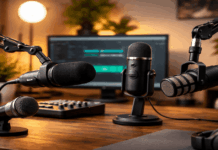
Condenser microphones are popular for home video, streaming, voiceovers, and music because they can sound clear and present.
They also create confusion because a good result depends on room noise, placement, and basic setup choices more than brand names.
These myths and truths focus on practical home use with simple gear like stands, pop filters, interfaces, USB mics, and quiet recording habits.
Myth 1: A condenser mic is always better than a dynamic mic
Many home users buy a condenser because they assume “more sensitive” automatically means “more professional.”
That sensitivity often picks up more room sound, keyboard clicks, and street noise in everyday rooms.
A dynamic mic can sound cleaner in the same space because it rejects more background sound at normal speaking distance.
“Better” depends on your room, your voice, your distance to the mic, and how consistent you can be on camera.
Truth: The best is the one that matches room and workflow
If your room is noisy or reflective, a dynamic mic close to your mouth may beat a condenser in real-world clarity.
If your room is quiet and you can control distance, a condenser can capture a natural voice tone with less effort.
Choose based on the sound you can repeat every time, not the spec sheet that looks most impressive.
Myth 2: You need a very expensive audio interface
People see studio creators with big interfaces and assume that price is a requirement for clean sound.
In reality, many entry-level interfaces provide stable phantom power and quiet enough preamps for home voice work.
The biggest quality jump usually comes from placement, pop filtering, and room control, not from upgrading the box.
If your recording chain is inconsistent, expensive gear can make mistakes louder instead of making results better.
Truth: A basic interface with phantom power is often enough
Look for an interface that offers 48V phantom power, a headphone output, and a gain knob with usable range.
Spend time learning input level, distance, and monitoring because those choices decide whether your takes are clean.
If you later outgrow the interface, you will know exactly why, which prevents random upgrades that do not fix the real issue.
Myth 3: Condenser mics are unusable without foam panels
This myth scares people into thinking they cannot record until they rebuild a room like a studio.
Most home creators do not need full treatment, and foam panels alone do not stop outside noise anyway.
What ruins condenser recordings is usually hard reflections near the mic, not the lack of a perfect “treated” space.
A small change in location, mic angle, and distance can reduce echo more than buying a pile of panels.
Truth 3: Smart placement and simple control is enough
Record closer to the mic, lower the gain, and keep the mic aimed away from noisy sources like fans and windows.
Use a rug, curtains, bookshelves, or a soft blanket behind the camera position to reduce sharp reflections.
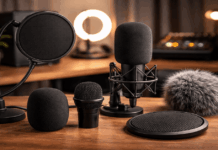
If you want an accessory, a decent stand, shock mount, and pop filter usually help more than covering walls at random.
Myth 4: The more sensitive the condenser, the more “detail”
Sensitivity does not replace proper levels, and high gain can raise hiss, room noise, and computer hum.
When you crank gain, you also make plosives and mouth noises harsher, which can be distracting in close-up video.
Some creators chase detail by speaking too far away, then boosting gain, which increases echo and reduces presence.
A condenser can sound thin or boxy if you record at the wrong distance and then try to fix it with volume.
Truth: Comes from correct distance, calm levels, and controlled bursts
Stay close enough for a strong signal, then set gain so normal speech peaks safely without clipping.
Use a pop filter and speak slightly across the mic capsule to soften “P” and “B” blasts without killing clarity.
If you want more brightness, adjust mic angle and placement first, then use light EQ after you already captured a clean take.
Myth 5: USB condenser mics cannot make professional content
USB mics get dismissed because they bundle the mic and interface, which sounds less serious than an XLR setup.
A lot of home content is watched on phones, and a well-used USB condenser can sound excellent in that reality.
The main limits are monitoring, placement options, and upgrade flexibility, not the ability to record a clean voice.
If your lighting and framing are strong, a stable USB audio track can be the difference between “watchable” and “clicked away.”
Truth: USB condenser can be a smart choice for simple, repeatable setups
Pick a USB mic with a headphone jack for zero-latency monitoring and a sturdy stand that fits your shooting space.
Treat it like any other mic by managing distance, using a pop filter, and keeping it off the desk if bumps are a problem.
When you outgrow it, you can move to XLR, but you will carry over the skills that actually create quality.
Myth 6: Phantom power is dangerous
Phantom power is often described like a risky “extra voltage” switch that should only be used by experts.
This fear leads people to avoid condensers or to turn settings on and off while monitoring at high volume.
Most modern condensers are designed for 48V phantom power, and most interfaces deliver it in a controlled way.
The real risk is careless plugging and unplugging, especially with headphones loud, not phantom power itself.
Truth: Phantom power is normal for XLR condensers
Turn phantom power on only when the mic is connected, and lower headphone volume before changing cables.
Avoid hot-swapping microphones while phantom power is on, and give it a moment to stabilize after switching.
If you use dynamic mics too, remember that phantom power is usually fine with balanced dynamics, but it is not needed for them.
Myth 7: Condenser mics are too fragile and cannot handle loud
People imagine condensers as delicate studio tools that break if you speak loudly or record anything stronger than a whisper.
That idea pushes home musicians into poor placement habits because they back away too far to “protect” the mic.
Many condensers handle high sound levels, but they will distort if your input gain is set wrong or your distance is inconsistent.
A loud source is not the enemy, and the real problem is clipping somewhere in the chain.
Truth 7: Condensers can handle real sound levels
Set conservative gain, keep peaks below clipping, and use consistent distance so your loud moments do not overload the input.
If your mic has a pad switch, use it when recording louder sources, but treat it as a tool, not a requirement.
A shock mount, stable stand, and careful cable routing protect the mic better than fear-based recording habits.
Conclusion
Condenser microphones are not magic, and they are not a trap, but they reward controlled setups and repeatable habits.
If you combine a stable mount, a pop filter, good placement, and clean levels, your audio improves more than any single upgrade.
Pick a setup you can use every day, test it on the platforms where you publish, and adjust based on what your audience actually hears.