Home creators usually wonder why their voice still sounds “blasty,” “puffy,” or distorted on certain words.
In many cases, the fix is a small accessory: a pop filter or a windscreen.
These tools are inexpensive compared with a new mic, and they help you get cleaner takes faster.
What is The Difference Between a Pop Filter and a Windscreen
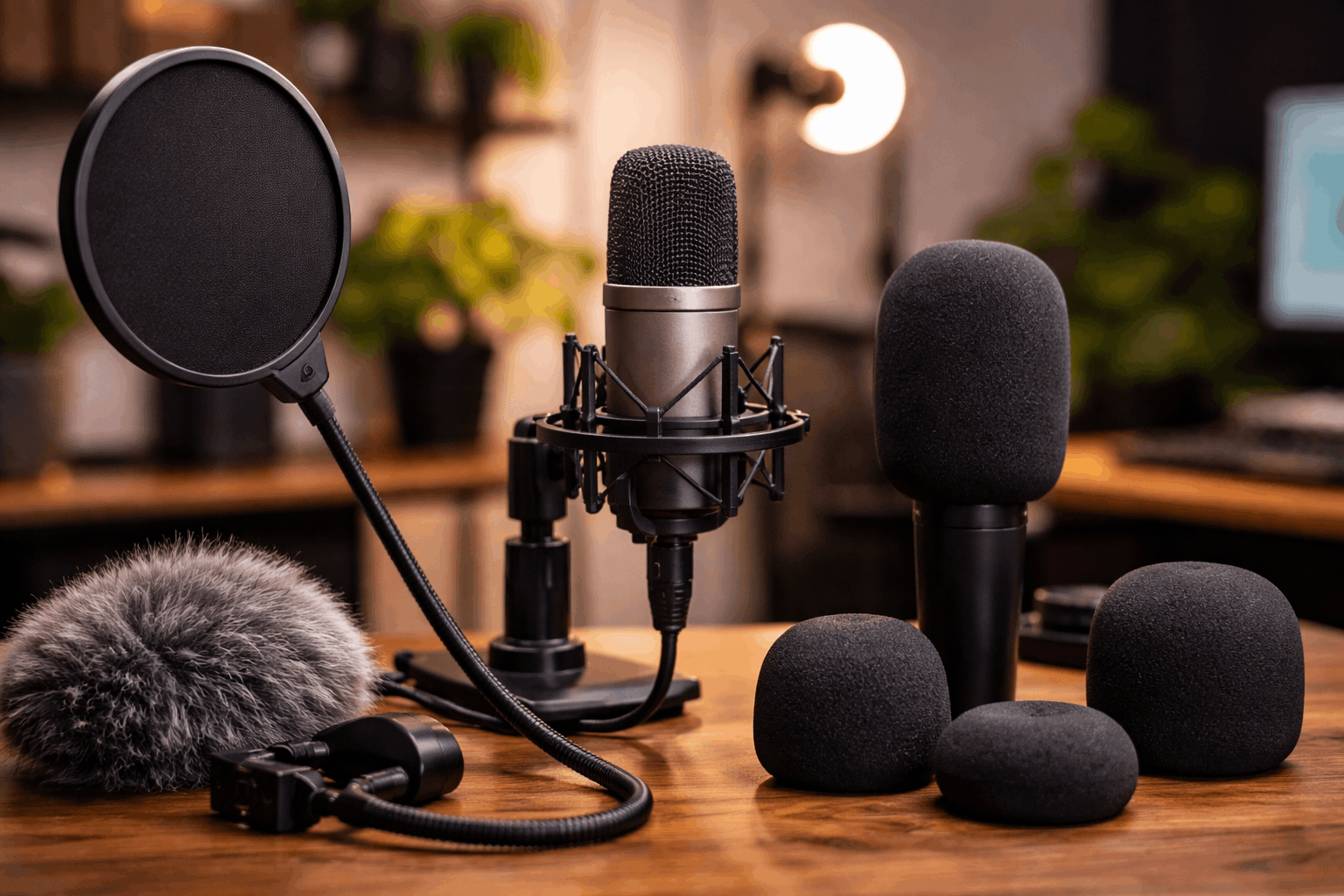
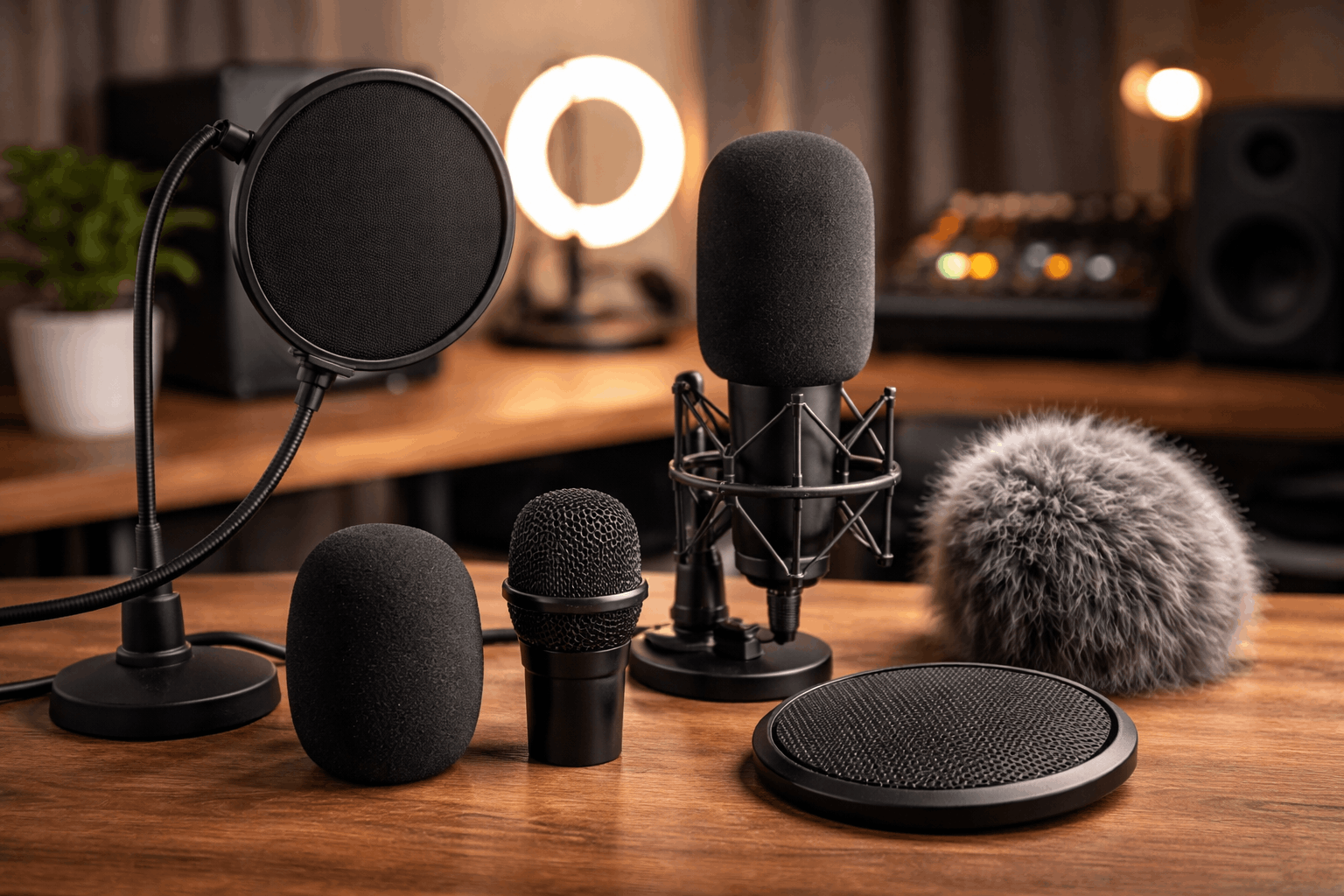
A pop filter is usually a mesh screen placed a few inches in front of the microphone to reduce plosive bursts (like “P,” “B,” “T,” “K”).
A windscreen is a foam or furry cover that fits over the microphone head or capsule area to reduce wind current.
Both tools reduce excessive pressures on a mic element (wind current, breath blasts, and vocal plosives) and can sometimes overlap in what they help with.
Pop Filter or Windscreen: How to Choose For Common Home Setups
If you record spoken voice indoors (podcasts, YouTube voiceovers, streaming), a pop filter is often the first buy.
This is because plosives are the most common problem at close mic distances.
If you record on-camera with a mic in frame and want the cleanest look, a fitted windscreen can be simpler.
A windscreen becomes more important if you have:
- A desk fan, AC draft, or you record near an open window.
- Outdoor shoots (even light wind can ruin dialogue).
- A camera/shotgun mic that sits above the frame and catches air movement easily.
Shure’s wind-noise guidance is consistent with this: wind is persistent, and reducing it often requires accessories plus good mic technique.
Pop Filter and Windscreen Together: When it Makes Sense
Using a pop filter and a windscreen together can be practical when you record close, speak energetically, or you’re in a room with airflow you can’t control.
They can sometimes be used interchangeably, which is another way of saying they overlap.
However, stacking them can help when you’re fighting both plosives and air movement at the same time.
The tradeoff is that adding layers in front of a mic can slightly change the tone or reduce brightness, depending on the material and how close you speak.
What’s Better Pop Filter or a Windscreen
For most indoor home creators, a pop filter is usually “better” as the first purchase because it targets plosives directly.
A windscreen is “better” when wind/air movement is the main issue—outdoors, near fans, or when you use a mic that’s easily hit by breath turbulence.
Top Pop Filters to Buy for Home Use
1) Stedman Proscreen XL (premium, durable)
A more rigid, engineered approach that redirects airflow rather than only diffusing it, and it’s a common choice for voice work.
Price example: $84.99 at Guitar Center.
Best for: creators who record often and want a “buy once” pop filter.
2) Shure PS-6 Popper Stopper (reliable studio standard)
Shure describes the PS-6 as a pop-elimination tool with a multi-layer screen and flexible positioning.
Price example: $44.99 at CDW (listed as discounted from $48.00).
Best for: spoken-word creators who want a sturdy clamp-and-gooseneck filter.
3) On-Stage ASVS6-B (solid value, widely compatible)
This is a classic nylon-style pop filter format that’s easy to mount and replace.
Price example: $27.95 at Full Compass Systems.
Best for: beginners building a simple desk setup with a USB mic or entry XLR mic.
4) RØDE WS14 (best if you use a RØDE PodMic / PodMic USB)
Fitted filters are convenient when you want fewer parts on screen and consistent placement.
Price example: $29.00 at Sweetwater.
Best for: PodMic owners who want a clean look for webcam shots.
5) Aokeo budget pop filters (lowest-cost starter options)
Aokeo lists multiple pop filters at entry prices, including metal/mesh options, depending on model.
Price examples: $12.99 for “F-pop” and $9.99 for “U-pop” on Aokeo’s store pages.
Best for: creators who need a quick fix on plosives with minimal spend.
Top Windscreens for Home and Light Outdoor Use
1) RØDE WS2 foam windscreen (fits many large-diaphragm/broadcast mics)
RØDE’s WS2 is a common foam windscreen choice for compatible RØDE microphones and similar sizes.
Price example: $29.00 at Sweetwater.
Best for: indoor creators with a broadcast-style mic who want simple, on-mic protection.
2) Shure A81WS large foam windscreen (great for specific Shure mic shapes)
Shure positions the A81WS as a foam windscreen to reduce unwanted breath and wind noise for mics like the SM81 and SM57-
Price example: $42.00 at Guitar Center.
Best for: users of compatible Shure mics who want strong foam protection.
3) Proline PLWS5 pack (multi-pack for handhelds or spares)
Multi-packs are practical if you run multiple mics, do interviews, or want backups.
Price example: $14.99 at Guitar Center.
Best for: creators managing several mics or doing casual group recordings.
4) Deity W02 (furry wind protection for small shotgun mics)
Deity sells the W02 as a purpose-fit windscreen for specific S-Mic models.
Price example: $25.00 on Deity Microphones’s store listing.
Best for: creators using a small shotgun mic for video and needing wind control.
5) Rycote Classic Softie (higher-end outdoor wind control)
Rycote’s Classic Softie line is widely used for location recording and uses a foam core with a fur layer.
Price example: listed from $105.00 at trewaudio.com (varies by size).
Best for: frequent outdoor recording where wind noise is a consistent risk.
Quick Buying Rules That Keep Your Setup Simple
If you mostly record indoors, close to the mic, start with a pop filter (plosives are the usual problem).
If you record near fans/AC or do outdoor clips, prioritize a windscreen.
If you still hear pops after adding one accessory, try a pop filter and windscreen together, then adjust the distance and mic angle to avoid a dull sound.
Conclusion
If you’re building a home creator kit, pop control is one of the cheapest upgrades that immediately improves perceived quality.
The best answer to what’s better, a pop filter or a windscreen, depends on your room and your recording style.
Combining both tools can solve stubborn cases without buying a new mic.